





















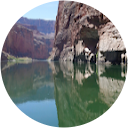






























James Hagadorn with a landslide that’s been glued together by travertine.
The Grand Canyon has some of the most interesting and best exposed rocks on earth. That’s why it’s a mecca for geologists, who return again and again to study its stone. Yet people often ask me, “Why go back? These rocks have been known for ages…don’t we already know everything about them?”
Indeed, we do know these rocks, but with new techniques, like lasers that can zap microscopic crystals to reveal their age, our return trips become a trove of new discoveries. For example, colleagues and I have recently used such crystals, along with cockroach-like fossils called trilobites, to figure out how the bottommost horizontal strata of the canyon formed. It turns out these rocks, called the Tonto Group, were deposited very quickly, about 500 million years ago, along the edge of a rather flat, plant-less Coastline.

The crescent-shaped outlines are slices through fossil shells in a limestone rock.
You too, can tap into next-level geology on your river trip. As you go down the canyon, you’ll pass over a billion years’ worth of sedimentary layers, built up as ancient environments left their sand, mud, and shells behind. Ask your guide to help you look at the tops of the ramp-like sandstone beds left behind by a dunefield in the 280 million-year-old Coconino Sandstone. You just might see the tracks of a primitive amphibian that once ambled across them!
Beneath these layered strata, in the deepest parts of the canyon, keep your eyes peeled for the nearly two billion-year-old rocks of the Granite Gorge. Here, the canyon’s sidewalls have been polished like countertops, sandblasted day and night by the sediment-laden Colorado River. Look closely, and you’ll see that these rocks, born in the bowels of an ancient continent, are chockablock full of crystals—some of which are rich in the rare earth elements that are so critical to our electronic world.
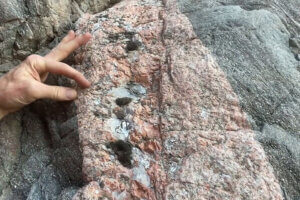
Smoky quartz, mica, and feldspar crystals that grew inside a giant vein of underground lava, or magma.
On your journey, you’ll also pass evidence for volcanoes, young and old. Some of them cross-cut the layered rocks, showing where underground lava sought to escape as our continent stretched and strained millions of years ago. Elsewhere, you’ll see where they punctured the surface, leaving cone-shaped monuments behind. Some of them spewed so much lava that they dammed the river and left behind bizarre lava mosaics that look like giant pick-up-sticks.
Best of all, relish the springs. As you splash amongst their subterranean waters, know that you’re bathing in one of the biggest sources of the Colorado River’s flow. What’s even cooler about these effervescent waters is that they carry gases from the deep interior of our planet. A place that we can only visit in the movies or in our imagination, notwithstanding Jules Verne and Bruce Willis. My advice for your canyon trip? Disconnect. Resist the urge to tether to rim world, and tophoto document every moment of your journey. When in camp or side canyons, look down, look to the side, and get a bit dirty. I’ll bet you’ll spot some rocks that have been twisted like taffy, or perhaps a crystal, a fossil, or two! If you need a geo primer, an easy-to-read one is here.